
Freedom
Sermon given on October 3, 2010 by The Rev. Jon Roberts
Good Shepherd Episcopal, Venice, Florida
Title
THE LIGHT
BLACK & WHITE XP Ministries

The Good News of Jesus Christ
as told by Father Jon Roberts
Since 2012

Lost In The Weeds
Matthew 13:24-30,36-43
The Rev. Jon Roberts
19 July
2026
Calvary Episcopal Church
24 Another parable he put before them, saying, “The kingdom of heaven may be compared to a man who sowed good seed in his field; 25 but while men were sleeping, his enemy came and sowed weeds among the wheat, and went away. 26 So when the plants came up and bore grain, then the weeds appeared also. 27 And the servants of the householder came and said to him, ‘Sir, did you not sow good seed in your field? How then has it weeds?’ 28 He said to them, ‘An enemy has done this.’ The servants said to him, ‘Then do you want us to go and gather them?’ 29 But he said, ‘No; lest in gathering the weeds you root up the wheat along with them. 30 Let both grow together until the harvest; and at harvest time I will tell the reapers, Gather the weeds first and bind them in bundles to be burned, but gather the wheat into my barn.’”
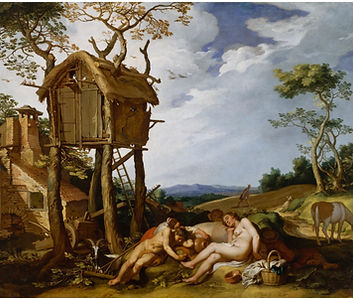
Parable of the wheat and tares, Abraham Bloemaert, 1624
The Walters Museum, Ultrecht, Netherlands
If you have a hard time
going to the Lord on your knees
You can be certain
that you will get lost in the weeds.
An elderly gardener had cultivated vegetables for nearly fifty years. Every spring, his grandson wanted to help. The boy's favorite job was pulling weeds. He attacked the garden with enthusiasm. One afternoon the grandfather returned to find neat piles of green plants scattered everywhere. "What happened?" he asked. "I did great!" the grandson beamed. "I pulled almost every weed." The old man knelt down. "You pulled most of the onions." The boy looked confused. "But they looked exactly like the weeds." The grandfather smiled gently. "That's because you're too young to know the difference."
The child asked the obvious question. "Then why did you let me do it?" "I wanted to teach you that sometimes the greatest damage in a garden comes from someone who is absolutely certain." For the rest of that season, the grandfather gave him a different task. "Water them." "When do I get to pull weeds?" "When you've learned to love the garden more than you love being right."
If you have a hard time
going to the Lord on your knees
You can be certain
that you will get lost in the weeds.
I think Jesus is saying something remarkably similar. The servants in the parable are eager. They ask, "Shall we go and gather the weeds?" Jesus says, "No." Why? Not because weeds don't matter. Not because evil isn't real. But because our judgment is often immature. We don't always know what we're looking at. We see only a moment in someone's life. God sees the entire harvest.
Think of Saul of Tarsus. Had the servants uprooted him, there would have been no Paul the Apostle.
Think of Peter. He looked like a weed the night he denied Jesus three times. Jesus saw wheat.
Think of the thief on the cross. At noon he looked like a weed. By sunset he was in Paradise.
Abraham Bloemaert, a Dutch master, painted the “Parable of the Wheat & Tares” from the Gospel of Matthew. The devil, identified by his horns and tail, sows weeds (or tares) in the field where wheat has been planted, while the lazy peasants are sleeping. Christians considered sloth one of the Seven Deadly Sins to which mankind was subject because of the Original Sin of Adam and Eve, to whom the two naked sleepers allude. The dovecote (a birdhouse to attract doves or pigeons that can be trapped for food without the bother of raising them) was associated with the morally lazy who take the easy way. The goat, known for its lust, alludes to self-indulgence, and the peacock, to pride.
I also think about the individual Christian as deeply affected by this parable. St. Augustine, preaching on this passage, reminded his congregation that the field is the world, but the world runs right through every human heart. (He did not deny the outward meaning, but he continually urged believers to examine themselves before condemning others.) Every disciple contains both flourishing grace and stubborn sin. Until the final harvest, sanctification is the patient work of God.
The greatest weed in my life is not my neighbor. It is the pride that convinces me I have become the gardener. From that, other sins enter. If we couch in our sloth, self-indulgent temptations we recline in sin and the seed of the evil one can grow in us. But, if we take the problem head on, on our knees, when every moment of temptation enters, Jesus finds the wheat. On our knees we have a better view of both the wheat and the weeds. On our knees, we learn the difference between the two.
Remember this,
If you have a hard time
going to the Lord on your knees
You can be certain
that you will get lost in the weeds.